Included with subscription
A subscription unlocks every workbook. Preview chapters are always free.
Subscribe for full accessSign in to start previewFirst 6 lessons free. Adds to your library so you can pick up later.
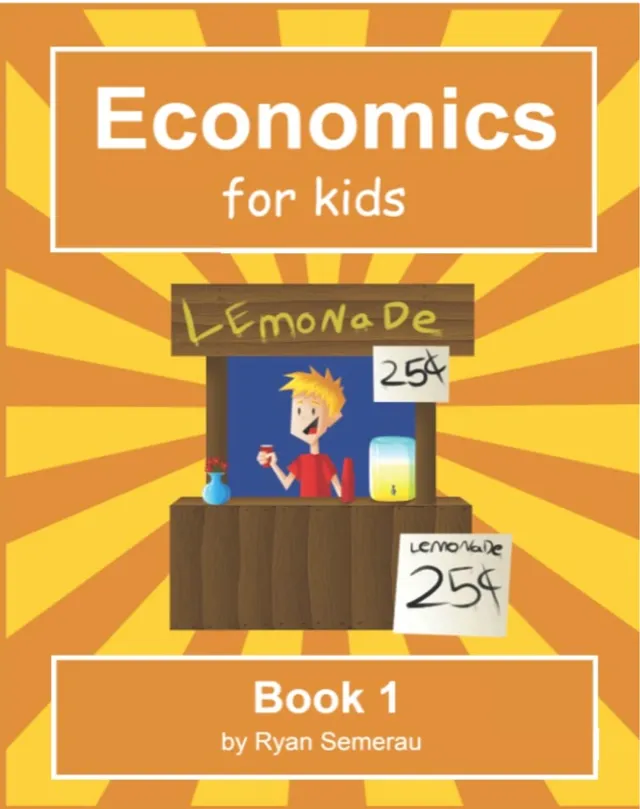
Economics for Kids — Book 1
by Ryan Semerau
An approachable first introduction to economics for elementary and middle school readers. No math, no charts, no jargon — just plain-language explanations and everyday examples that build real intuition for how people make choices and how markets work. Designed as a self-study workbook with a friendly AI tutor on hand for every lesson.
Contents
16 chapters · 76 lessons · first 6 free- IntroductionFree
1 · Choice
- 1.1 · LimitsFree
- 1.2 · The 5 Required Aspects of ChoiceFree
- 1.3 · ScarcityFree
- 1.4 · Definition of EconomicsFree
- Chapter 1 TestFree
2 · Demand
- 2.1 · What is demand?Free
- 2.2 · The 5 Factors of Demand🔒
- 2.3 · Changes in demand🔒
- 2.4 · Demand is everywhere🔒
- Chapter 2 Test🔒
3 · Supply
- 3.1 · What is supply?🔒
- 3.2 · The 6 Factors of Supply🔒
- 3.3 · Changes in supply🔒
- 3.4 · Supply is everywhere🔒
- Chapter 3 Test🔒
4 · Trade
- 4.1 · Why trade?🔒
- 4.2 · Types of trade🔒
- 4.3 · Differing values🔒
- 4.4 · Trade is all around us🔒
- Chapter 4 Test🔒
5 · Money
- 5.1 · Barter🔒
- 5.2 · What is money?🔒
- 5.3 · Properties of money🔒
- 5.4 · History of money🔒
- Chapter 5 Test🔒
6 · Markets
- 6.1 · What is a market?🔒
- 6.2 · Fair markets🔒
- 6.3 · Other unfair practices🔒
- 6.4 · Competition🔒
- Chapter 6 Test🔒
7 · Price
- 7.1 · What is price?🔒
- 7.2 · How prices are decided🔒
- 7.3 · Prices contain information🔒
- 7.4 · Prices are everywhere🔒
- Chapter 7 Test🔒
8 · Production
- 8.1 · Land🔒
- 8.2 · Labor🔒
- 8.3 · Capital🔒
- 8.4 · Trade-offs🔒
- Chapter 8 Test🔒
9 · Specialization
- 9.1 · What is specialization?🔒
- 9.2 · Benefits of specialization🔒
- 9.3 · Downsides of specialization🔒
- 9.4 · Specialization in the market🔒
- Chapter 9 Test🔒
10 · Efficiency
- 10.1 · What is Efficiency?🔒
- 10.2 · Efficient use of 3 Factors of Production🔒
- 10.3 · Efficiency is always changing🔒
- 10.4 · Benefits of efficiency🔒
- Chapter 10 Test🔒
11 · Profit
- 11.1 · What is profit?🔒
- 11.2 · Fixed costs🔒
- 11.3 · Variable costs🔒
- 11.4 · Change prices for profit🔒
- Chapter 11 Test🔒
12 · Opportunity Cost
- 12.1 · What is Opportunity Cost?🔒
- 12.2 · More about opportunity costs🔒
- 12.3 · Life decisions🔒
- 12.4 · Opportunity costs are everywhere🔒
- Chapter 12 Test🔒
13 · Comparative Advantage
- 13.1 · Absolute Advantage🔒
- 13.2 · Using Opportunity Cost🔒
- 13.3 · Comparative Advantage🔒
- 13.4 · More on Comparative Advantage🔒
- Chapter 13 Test🔒
14 · Elasticity
- 14.1 · Elastic and inelastic demand🔒
- 14.2 · What is elasticity?🔒
- 14.3 · Income elasticity🔒
- 14.4 · Other elasticities🔒
- Chapter 14 Test🔒
15 · Short-run vs Long-run
- 15.1 · Changes over time🔒
- 15.2 · Elasticity affects the short-run🔒
- 15.3 · Changes in the short-run🔒
- 15.4 · Characteristics of the Long-run🔒
- Chapter 15 Test🔒
What you'll learn
- ✓Why we have to make choices, and what scarcity really means
- ✓How demand and supply work, in everyday terms
- ✓Why people trade, and what makes trade fair
- ✓What money is, and why it works better than barter
- ✓How prices form, and what they tell us
- ✓How specialization, efficiency, and profit shape what gets made
- ✓Opportunity cost and comparative advantage — the real definition of economics
How to use this workbook
15 chapters, designed for one chapter per week (4 short lessons per week). Each lesson takes about 15–20 minutes — read the lesson, talk it over with the AI tutor, then answer a few short questions in your own words. Your work is graded by the tutor and you can take a chapter as many times as you need.
Prerequisites
None. Reading at roughly a 3rd-grade level is enough.