Included with subscription
A subscription unlocks every workbook. Preview chapters are always free.
Subscribe for full accessSign in to start previewFirst 6 lessons free. Adds to your library so you can pick up later.
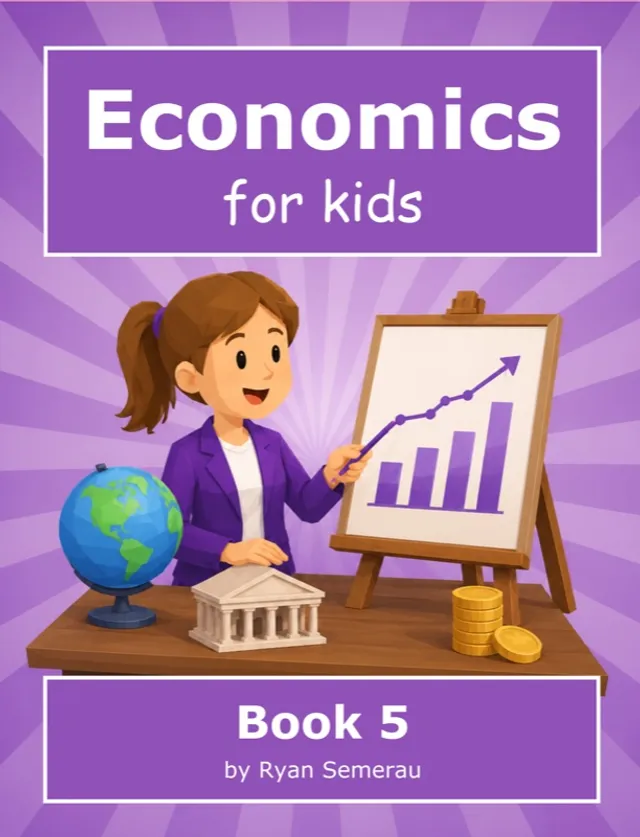
Economics for Kids — Book 5
by Ryan Semerau
The fifth book in the Economics for Kids series. Introduces macroeconomics — GDP, inflation, unemployment, business cycles, monetary and fiscal policy, government debt, trade, and financial crises. Big-picture economics explained simply for young readers.
Contents
16 chapters · 76 lessons · first 6 free- IntroductionFree
1 · The Big Picture
- 1.1 · Households and FirmsFree
- 1.2 · The Circular FlowFree
- 1.3 · Prices as SignalsFree
- 1.4 · Institutions and RulesFree
- Chapter 1 TestFree
2 · GDP and Measurement
- 2.1 · What GDP IsFree
- 2.2 · What Counts in GDP🔒
- 2.3 · What GDP Misses🔒
- 2.4 · Real vs. Nominal GDP🔒
- Chapter 2 Test🔒
3 · Inflation and Measurement
- 3.1 · The Price Level🔒
- 3.2 · The CPI Basket🔒
- 3.3 · Why Inflation Is Hard to Measure🔒
- 3.4 · Why Inflation Matters🔒
- Chapter 3 Test🔒
4 · Unemployment and Measurement
- 4.1 · What Unemployment Means🔒
- 4.2 · Types of Unemployment🔒
- 4.3 · Participation and Underemployment🔒
- 4.4 · Why Unemployment Matters🔒
- Chapter 4 Test🔒
5 · Productivity
- 5.1 · Output per Hour🔒
- 5.2 · Human Capital🔒
- 5.3 · Tools and Technology🔒
- 5.4 · Productivity and Living Standards🔒
- Chapter 5 Test🔒
6 · Economic Growth
- 6.1 · What Growth Means🔒
- 6.2 · Investment and Capital🔒
- 6.3 · Innovation and Institutions🔒
- 6.4 · Growth and Distribution🔒
- Chapter 6 Test🔒
7 · Business Cycles
- 7.1 · Expansion and Recession🔒
- 7.2 · Why Cycles Happen🔒
- 7.3 · Measuring the Cycle🔒
- 7.4 · Stabilizing the Cycle🔒
- Chapter 7 Test🔒
8 · Aggregate Spending
- 8.1 · Total Spending🔒
- 8.2 · The Spending Ripple🔒
- 8.3 · Consumption and Confidence🔒
- 8.4 · Investment and Volatility🔒
- Chapter 8 Test🔒
9 · Supply Shocks and Constraints
- 9.1 · Supply vs. Demand Problems🔒
- 9.2 · Bottlenecks and Capacity🔒
- 9.3 · Stagflation🔒
- 9.4 · Responding to Supply Shocks🔒
- Chapter 9 Test🔒
10 · Fiat Money and the Central Bank
- 10.1 · Money in a Modern Economy🔒
- 10.2 · What a Central Bank Does🔒
- 10.3 · Interest Rates as a Policy Tool🔒
- 10.4 · Beyond Rates🔒
- Chapter 10 Test🔒
11 · Monetary Policy Transmission
- 11.1 · The Transmission Mechanism🔒
- 11.2 · The Lending Channel🔒
- 11.3 · Asset Prices🔒
- 11.4 · Expectations🔒
- Chapter 11 Test🔒
12 · Fiscal Policy and Automatic Stabilizers
- 12.1 · Spending and Taxes🔒
- 12.2 · Automatic Stabilizers🔒
- 12.3 · Deficits and Surpluses🔒
- 12.4 · Timing and Tradeoffs🔒
- Chapter 12 Test🔒
13 · Government Debt
- 13.1 · Borrowing and Bonds🔒
- 13.2 · Who Holds the Debt🔒
- 13.3 · Debt Sustainability🔒
- 13.4 · Inflation, Default, and Restructuring🔒
- Chapter 13 Test🔒
14 · Trade and Exchange Rates
- 14.1 · Why Trade Happens🔒
- 14.2 · Trade Balances🔒
- 14.3 · Exchange Rates🔒
- 14.4 · Currency Effects🔒
- Chapter 14 Test🔒
15 · Crises and Stabilization
- 15.1 · What a Crisis Is🔒
- 15.2 · Credit Crunch🔒
- 15.3 · Crisis Tools🔒
- 15.4 · Building Resilience🔒
- Chapter 15 Test🔒
What you'll learn
- ✓How to think about the economy as a system
- ✓What GDP is and how we measure economic output
- ✓What inflation is, how it's measured, and why it matters
- ✓What unemployment means and how it's tracked
- ✓Why productivity drives long-run growth
- ✓What business cycles are and why economies fluctuate
- ✓How central banks use monetary policy to stabilize the economy
- ✓What fiscal policy is and how automatic stabilizers work
- ✓Why governments borrow and what government debt means
- ✓How international trade and exchange rates connect economies
How to use this workbook
15 chapters, designed for one chapter per week (4 short lessons per week plus a chapter test). Each lesson takes about 15–20 minutes — read the lesson, talk it over with the AI tutor, then answer a few short questions in your own words. Your work is graded by the tutor and you can retake a chapter as many times as you need.
Prerequisites
Completion of Economics for Kids Books 1–4, or a solid understanding of microeconomics, personal finance, and banking basics.