Included with subscription
A subscription unlocks every workbook. Preview chapters are always free.
Subscribe for full accessSign in to start previewFirst 6 lessons free. Adds to your library so you can pick up later.
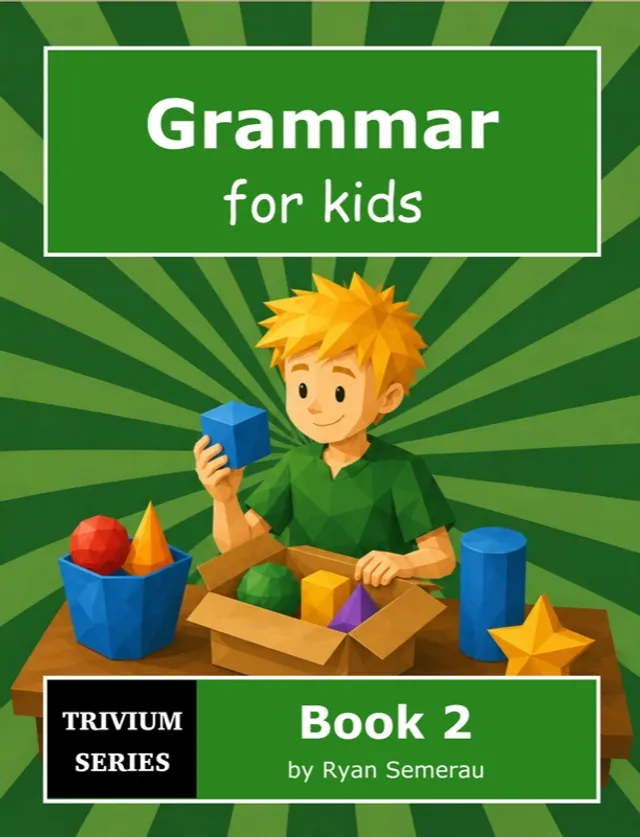
Grammar for Kids - Book 2
by Ryan Semerau
The second book in the Grammar for Kids series. Builds on Book 1's foundation of terms to teach how terms relate to each other - predication, modification, case relationships, possession, identity, spatial and temporal relationships, cause and effect, comparison, quantification, voice, coordination, subordination, negation, and mood. Examples from multiple languages show that these relationships are universal.
Contents
16 chapters · 76 lessons · first 6 free- IntroductionFree
1 · Fundamental Relationships
- 1.1 · Terms Need Each OtherFree
- 1.2 · Different Kinds of RelationshipsFree
- 1.3 · Relationships Are UniversalFree
- 1.4 · Relationships Are the GrammarFree
- Chapter 1 TestFree
2 · Predication - Saying Something About Something
- 2.1 · The Most Fundamental RelationshipFree
- 2.2 · Essential Predication🔒
- 2.3 · Accidental Predication🔒
- 2.4 · The Predicables🔒
- Chapter 2 Test🔒
3 · Modification - Adding Information
- 3.1 · What Is Modification🔒
- 3.2 · Modifying Names (Attribution)🔒
- 3.3 · Modifying Actions and Other Modifiers🔒
- 3.4 · Degree🔒
- Chapter 3 Test🔒
4 · Case Relationships - Who Did What to Whom
- 4.1 · Roles in an Action🔒
- 4.2 · The Agent🔒
- 4.3 · The Patient🔒
- 4.4 · Other Roles🔒
- Chapter 4 Test🔒
5 · Case Systems
- 5.1 · What Is a Case System🔒
- 5.2 · The Latin Cases🔒
- 5.3 · Rich Case Systems🔒
- 5.4 · Languages Without Case Endings🔒
- Chapter 5 Test🔒
6 · Possession and Identity
- 6.1 · Possession: What Belongs to What🔒
- 6.2 · Types of Possession🔒
- 6.3 · Identity: Two Terms, One Thing🔒
- 6.4 · Equivalence and Difference🔒
- Chapter 6 Test🔒
7 · Spatial Relationships
- 7.1 · Location: Where Something Is🔒
- 7.2 · Direction and Movement🔒
- 7.3 · Source and Goal🔒
- 7.4 · How Languages Handle Space🔒
- Chapter 7 Test🔒
8 · Temporal Relationships
- 8.1 · Time as a Relationship Between Events🔒
- 8.2 · Sequence: Before, After, Then🔒
- 8.3 · Duration and Simultaneity🔒
- 8.4 · Tense: How Languages Mark Time🔒
- Chapter 8 Test🔒
9 · Causal Relationships
- 9.1 · Cause and Effect🔒
- 9.2 · Purpose: In Order To🔒
- 9.3 · Reason: Why🔒
- 9.4 · Condition: If...Then🔒
- Chapter 9 Test🔒
10 · Comparison and Degree
- 10.1 · Similarity and Difference🔒
- 10.2 · Degree: More and Less🔒
- 10.3 · Superlatives: The Extreme🔒
- 10.4 · Analogy and Proportion🔒
- Chapter 10 Test🔒
11 · Quantification
- 11.1 · How Many Are We Talking About🔒
- 11.2 · Universal Terms: All and Every🔒
- 11.3 · Particular Terms: Some, Many, Few🔒
- 11.4 · Definite and Indefinite🔒
- Chapter 11 Test🔒
12 · Active, Passive, and Voice
- 12.1 · Active Voice: The Agent in Focus🔒
- 12.2 · Passive Voice: The Patient in Focus🔒
- 12.3 · Why Voice Matters🔒
- 12.4 · Middle Voice and Other Voices🔒
- Chapter 12 Test🔒
13 · Coordination and Subordination
- 13.1 · Coordination: Joining Equals🔒
- 13.2 · Subordination: Nesting Relationships🔒
- 13.3 · Types of Subordination🔒
- 13.4 · Building Complexity🔒
- Chapter 13 Test🔒
14 · Negation, Questions, and Commands
- 14.1 · Negation: Saying What Isn't🔒
- 14.2 · Scope of Negation🔒
- 14.3 · Questions: Requesting Information🔒
- 14.4 · Commands and Mood🔒
- Chapter 14 Test🔒
15 · The Web of Relationships
- 15.1 · The Relationships You've Learned🔒
- 15.2 · Every Statement Is a Web🔒
- 15.3 · Relationships Are Universal, Expression Is Not🔒
- 15.4 · What Comes Next🔒
- Chapter 15 Test🔒
What you'll learn
- ✓Why terms need relationships to create meaning
- ✓How predication connects subjects and predicates
- ✓How modification adds detail and precision
- ✓The semantic roles in any action - agent, patient, instrument, recipient
- ✓How case systems mark relationships in different languages
- ✓How possession and identity work across languages
- ✓How spatial and temporal relationships are expressed
- ✓How cause, purpose, reason, and condition connect events
- ✓How comparison, degree, and analogy work
- ✓How quantification changes the meaning of a statement
- ✓How voice shifts perspective on an action
- ✓How coordination and subordination build complexity
- ✓How negation, questions, and commands go beyond simple assertion
How to use this workbook
15 chapters, designed for one chapter per week (4 short lessons per week plus a chapter test). Each lesson takes about 15-20 minutes - read the lesson, talk it over with the AI tutor, then answer a few short questions in your own words.
Prerequisites
Grammar for Kids Book 1. You should understand what terms are, how they refer to things, and how they are defined before starting this book.