Included with subscription
A subscription unlocks every workbook. Preview chapters are always free.
Subscribe for full accessSign in to start previewFirst 6 lessons free. Adds to your library so you can pick up later.
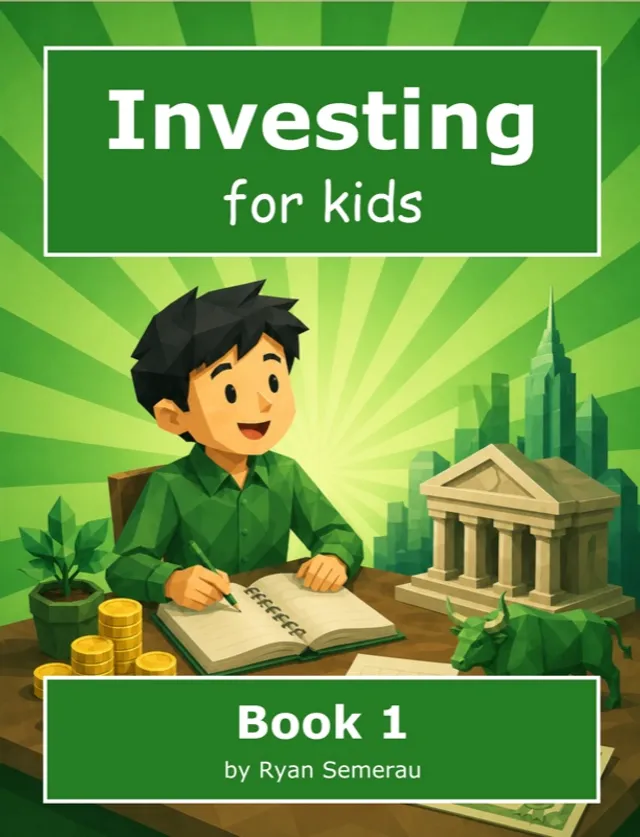
Investing for Kids - Book 1
by Ryan Semerau
The first book in the Investing for Kids series. Covers the foundations of investing - why it matters, how markets work, compound growth, and risk - then takes a deep dive into stocks and bonds, the two pillars every investor needs to understand. Real-world examples in plain language for young readers.
Contents
16 chapters · 76 lessons · first 6 free- IntroductionFree
1 · Foundations
- 1.1 · What Is InvestingFree
- 1.2 · Saving vs InvestingFree
- 1.3 · Inflation: The Silent ThiefFree
- 1.4 · Time Is Your SuperpowerFree
- Chapter 1 TestFree
2 · Compound Growth
- 2.1 · Simple InterestFree
- 2.2 · Compound Interest🔒
- 2.3 · The Snowball Effect🔒
- 2.4 · The Rule of 72🔒
- Chapter 2 Test🔒
3 · Risk and Return
- 3.1 · What Is Risk🔒
- 3.2 · Types of Risk🔒
- 3.3 · Risk-Return Tradeoff🔒
- 3.4 · Risk Tolerance🔒
- Chapter 3 Test🔒
4 · How Markets Work
- 4.1 · What Is a Market🔒
- 4.2 · Stock Exchanges🔒
- 4.3 · How Prices Are Set🔒
- 4.4 · Orders and Brokers🔒
- Chapter 4 Test🔒
5 · Brokers, Accounts, and Getting Started
- 5.1 · What Is a Brokerage Account🔒
- 5.2 · Account Types🔒
- 5.3 · Fees and Commissions🔒
- 5.4 · Reading an Account Statement🔒
- Chapter 5 Test🔒
6 · What Is a Stock?
- 6.1 · A Stock Is a Piece of Ownership🔒
- 6.2 · Why Companies Issue Stock🔒
- 6.3 · Common Stock vs Preferred Stock🔒
- 6.4 · Shares, Tickers, and Quotes🔒
- Chapter 6 Test🔒
7 · What Moves Stock Prices
- 7.1 · Earnings: The Engine🔒
- 7.2 · Expectations Matter More Than Reality🔒
- 7.3 · News, Events, and Sentiment🔒
- 7.4 · Supply and Demand for Shares🔒
- Chapter 7 Test🔒
8 · Evaluating Stocks
- 8.1 · Earnings Per Share (EPS)🔒
- 8.2 · Price-to-Earnings Ratio (P/E)🔒
- 8.3 · Market Capitalization🔒
- 8.4 · Dividend Yield and Book Value🔒
- Chapter 8 Test🔒
9 · Types of Stocks
- 9.1 · Growth Stocks vs Value Stocks🔒
- 9.2 · Size: Large Cap, Mid Cap, Small Cap🔒
- 9.3 · Sectors and Industries🔒
- 9.4 · Dividend Stocks and International Stocks🔒
- Chapter 9 Test🔒
10 · IPOs, Stock Splits, and Corporate Actions
- 10.1 · Going Public: The IPO🔒
- 10.2 · Why Companies Go Public🔒
- 10.3 · Stock Splits and Reverse Splits🔒
- 10.4 · Buybacks and Spinoffs🔒
- Chapter 10 Test🔒
11 · What Is a Bond?
- 11.1 · A Bond Is a Loan You Make🔒
- 11.2 · Face Value and Coupon🔒
- 11.3 · Maturity🔒
- 11.4 · Why Bonds Exist🔒
- Chapter 11 Test🔒
12 · Types of Bonds
- 12.1 · U.S. Treasury Securities🔒
- 12.2 · TIPS and Savings Bonds🔒
- 12.3 · Corporate and Municipal Bonds🔒
- 12.4 · Junk Bonds and Bond Ratings🔒
- Chapter 12 Test🔒
13 · Bond Prices, Yields, and Interest Rates
- 13.1 · Bond Prices and Interest Rates Move Opposite🔒
- 13.2 · Current Yield vs Yield to Maturity🔒
- 13.3 · The Yield Curve🔒
- 13.4 · Credit Spreads🔒
- Chapter 13 Test🔒
14 · Stocks vs. Bonds
- 14.1 · Ownership vs Lending🔒
- 14.2 · Risk Comparison🔒
- 14.3 · Income: Dividends vs Coupons🔒
- 14.4 · The Classic Mix🔒
- Chapter 14 Test🔒
15 · Your First Investment Decisions
- 15.1 · Start with a Goal🔒
- 15.2 · Time Horizon🔒
- 15.3 · Starting Small🔒
- 15.4 · Paper Trading🔒
- Chapter 15 Test🔒
What you'll learn
- ✓What investing is and why it matters
- ✓How compound growth makes your money snowball over time
- ✓What risk means and how to think about the risk-return tradeoff
- ✓How stock markets and exchanges work
- ✓What a stock is and what it means to own a piece of a company
- ✓How to evaluate stocks using key metrics like P/E ratio and EPS
- ✓The different types of stocks - growth, value, large cap, small cap
- ✓What bonds are and how lending money to companies and governments works
- ✓How bond prices, yields, and interest rates are connected
- ✓How to compare stocks and bonds and start making investment decisions
How to use this workbook
15 chapters, designed for one chapter per week (4 short lessons per week plus a chapter test). Each lesson takes about 15-20 minutes - read the lesson, talk it over with the AI tutor, then answer a few short questions in your own words.
Prerequisites
None required. Economics for Kids Book 1 (basic economics) and Accounting for Kids Book 2 (reading financial statements) are helpful but not strictly necessary - concepts are re-introduced as needed.