Included with subscription
A subscription unlocks every workbook. Preview chapters are always free.
Subscribe for full accessSign in to start previewFirst 6 lessons free. Adds to your library so you can pick up later.
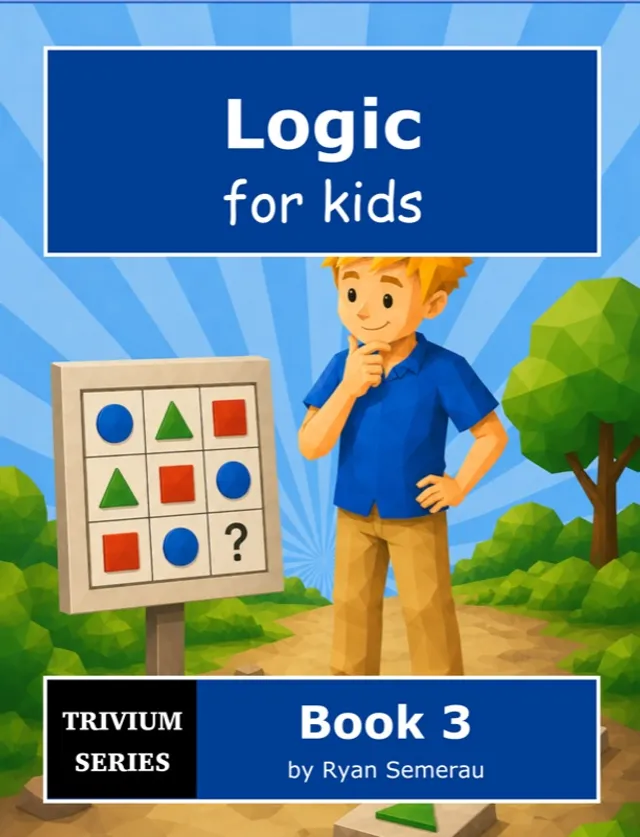
Logic for Kids - Book 3
by Ryan Semerau
The third book in the Logic for Kids series. Covers formal and informal fallacies in comprehensive detail - syllogistic fallacies, hypothetical fallacies, fallacies of relevance, fallacies of ambiguity, and fallacies of presumption. Teaches students to identify fallacies in real-world contexts and to construct strong arguments of their own.
Contents
16 chapters · 76 lessons · first 6 free- IntroductionFree
1 · Introduction to Fallacies
- 1.1 · What Is a FallacyFree
- 1.2 · Formal vs Informal FallaciesFree
- 1.3 · Why Fallacies Are PersuasiveFree
- 1.4 · Naming the ErrorFree
- Chapter 1 TestFree
2 · Formal Fallacies - Syllogistic
- 2.1 · Undistributed MiddleFree
- 2.2 · Illicit Major🔒
- 2.3 · Illicit Minor🔒
- 2.4 · The Four-Term Fallacy🔒
- Chapter 2 Test🔒
3 · Formal Fallacies - Hypothetical
- 3.1 · Affirming the Consequent🔒
- 3.2 · Denying the Antecedent🔒
- 3.3 · Why These Are So Common🔒
- 3.4 · Other Formal Errors🔒
- Chapter 3 Test🔒
4 · Fallacies of Relevance - Part 1
- 4.1 · Ad Hominem: Attacking the Person🔒
- 4.2 · Tu Quoque: "You Do It Too"🔒
- 4.3 · Appeal to Authority🔒
- 4.4 · Appeal to Force (Ad Baculum)🔒
- Chapter 4 Test🔒
5 · Fallacies of Relevance - Part 2
- 5.1 · Appeal to Pity (Ad Misericordiam)🔒
- 5.2 · Appeal to Emotion🔒
- 5.3 · Appeal to the People (Ad Populum)🔒
- 5.4 · Red Herring🔒
- Chapter 5 Test🔒
6 · Fallacies of Relevance - Part 3
- 6.1 · Straw Man🔒
- 6.2 · Genetic Fallacy🔒
- 6.3 · Appeal to Ignorance🔒
- 6.4 · Irrelevant Conclusion🔒
- Chapter 6 Test🔒
7 · Fallacies of Ambiguity
- 7.1 · Equivocation🔒
- 7.2 · Amphiboly🔒
- 7.3 · Accent and Emphasis🔒
- 7.4 · Composition and Division🔒
- Chapter 7 Test🔒
8 · Fallacies of Presumption - Part 1
- 8.1 · Begging the Question🔒
- 8.2 · Complex Question🔒
- 8.3 · False Dilemma🔒
- 8.4 · Loaded Language🔒
- Chapter 8 Test🔒
9 · Fallacies of Presumption - Part 2
- 9.1 · Hasty Generalization🔒
- 9.2 · Slippery Slope🔒
- 9.3 · False Cause🔒
- 9.4 · Accident and Converse Accident🔒
- Chapter 9 Test🔒
10 · Fallacies in Practice - Advertising and Media
- 10.1 · Fallacies in Advertising🔒
- 10.2 · Fallacies in the News🔒
- 10.3 · Fallacies in Social Media🔒
- 10.4 · Fallacies in Everyday Arguments🔒
- Chapter 10 Test🔒
11 · Fallacies in Longer Arguments
- 11.1 · Arguments Often Contain Multiple Fallacies🔒
- 11.2 · Fallacy Stacking🔒
- 11.3 · The Fallacy Fallacy🔒
- 11.4 · Charity and Precision🔒
- Chapter 11 Test🔒
12 · Constructing Strong Arguments
- 12.1 · Start with Clear Terms🔒
- 12.2 · Use Relevant Premises🔒
- 12.3 · Don't Assume What You're Trying to Prove🔒
- 12.4 · Anticipate Objections🔒
- Chapter 12 Test🔒
13 · Distinguishing Good Arguments from Bad
- 13.1 · The Evaluation Checklist🔒
- 13.2 · Good Arguments🔒
- 13.3 · Degrees of Quality🔒
- 13.4 · Practice: Complex Evaluations🔒
- Chapter 13 Test🔒
14 · Fallacies and Rhetoric
- 14.1 · Fallacies Are Persuasive by Design🔒
- 14.2 · The Ethics of Argument🔒
- 14.3 · Rhetoric Is Not Fallacy🔒
- 14.4 · From Logic to Rhetoric🔒
- Chapter 14 Test🔒
15 · The Fallacy Toolkit
- 15.1 · Formal Fallacies🔒
- 15.2 · Fallacies of Relevance🔒
- 15.3 · Fallacies of Ambiguity🔒
- 15.4 · Fallacies of Presumption🔒
- Chapter 15 Test🔒
What you'll learn
- ✓What a fallacy is and why fallacies are persuasive
- ✓Formal fallacies: undistributed middle, illicit major, illicit minor, four-term fallacy
- ✓Affirming the consequent and denying the antecedent
- ✓Fallacies of relevance: ad hominem, straw man, red herring, and more
- ✓Fallacies of ambiguity: equivocation, amphiboly, composition, division
- ✓Fallacies of presumption: begging the question, false dilemma, hasty generalization
- ✓How to spot fallacies in advertising, news, and social media
- ✓How to construct strong arguments that avoid fallacies
- ✓How to evaluate arguments systematically
- ✓How fallacies connect to the art of Rhetoric
How to use this workbook
15 chapters, designed for one chapter per week (4 short lessons per week plus a chapter test). Each lesson takes about 15-20 minutes - read the lesson, talk it over with the AI tutor, then answer a few short questions in your own words.
Prerequisites
Logic for Kids Books 1-2 (required). Grammar for Kids Books 1-3 strongly recommended.