Included with subscription
A subscription unlocks every workbook. Preview chapters are always free.
Subscribe for full accessSign in to start previewFirst 6 lessons free. Adds to your library so you can pick up later.
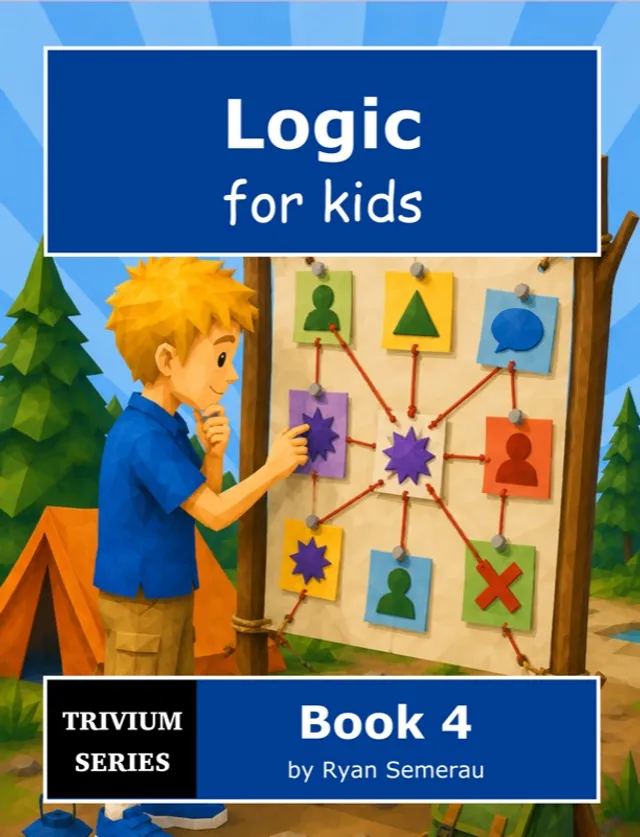
Logic for Kids - Book 4
by Ryan Semerau
The fourth and final book in the Logic for Kids series. Covers material logic - definition, division, the four causes, judgment, truth, knowledge, demonstration, induction, Mill's Methods, analogical reasoning, and practical reasoning. Completes the study of logic and prepares students for Rhetoric.
Contents
16 chapters · 76 lessons · first 6 free- IntroductionFree
1 · Definition, Division, and Categories
- 1.1 · What Is Material LogicFree
- 1.2 · Form vs MatterFree
- 1.3 · Why Form Isn't EnoughFree
- 1.4 · The Questions of Material LogicFree
- Chapter 1 TestFree
2 · Definition as a Logical Act
- 2.1 · Definition RevisitedFree
- 2.2 · Real Definition vs Nominal Definition🔒
- 2.3 · Essential Definition: Genus + Differentia🔒
- 2.4 · Rules for Good Definitions🔒
- Chapter 2 Test🔒
3 · Division as a Logical Act
- 3.1 · Three Kinds of Division🔒
- 3.2 · Logical Division in Detail🔒
- 3.3 · Rules for Good Division🔒
- 3.4 · Division and Classification🔒
- Chapter 3 Test🔒
4 · The Categories Revisited
- 4.1 · Categories as Logical Tools🔒
- 4.2 · Substance: The Primary Category🔒
- 4.3 · The Accidental Categories🔒
- 4.4 · Category Mistakes🔒
- Chapter 4 Test🔒
5 · The Predicables Revisited
- 5.1 · The Five Predicables as Evaluation Tools🔒
- 5.2 · Essential vs Accidental Predication in Reasoning🔒
- 5.3 · Necessary vs Contingent Propositions🔒
- 5.4 · Per Se and Per Accidens🔒
- Chapter 5 Test🔒
6 · The Four Causes
- 6.1 · What Is a Cause?🔒
- 6.2 · Material Cause: What It's Made Of🔒
- 6.3 · Formal Cause: What Makes It What It Is🔒
- 6.4 · Efficient Cause: What Brought It About🔒
- Chapter 6 Test🔒
7 · The Final Cause and Teleology
- 7.1 · Final Cause: What It's For🔒
- 7.2 · Teleology: Purpose in Nature🔒
- 7.3 · Understanding Through All Four Causes🔒
- 7.4 · Why Final Cause Matters for Reasoning🔒
- Chapter 7 Test🔒
8 · Judgment and Truth
- 8.1 · What Is Truth?🔒
- 8.2 · Judgment: Affirming or Denying Truth🔒
- 8.3 · Self-Evident Propositions🔒
- 8.4 · Degrees of Assent🔒
- Chapter 8 Test🔒
9 · Knowledge, Opinion, and Belief
- 9.1 · What Is Knowledge?🔒
- 9.2 · Opinion🔒
- 9.3 · Belief and Faith🔒
- 9.4 · The Spectrum of Intellectual States🔒
- Chapter 9 Test🔒
10 · Demonstration
- 10.1 · What Is Demonstration?🔒
- 10.2 · Premises of Demonstration🔒
- 10.3 · Demonstration "That" vs. Demonstration "Why"🔒
- 10.4 · First Principles🔒
- Chapter 10 Test🔒
11 · Induction
- 11.1 · What Is Induction🔒
- 11.2 · How Induction Differs from Deduction🔒
- 11.3 · Simple Enumeration🔒
- 11.4 · The Problem of Induction🔒
- Chapter 11 Test🔒
12 · Mill's Methods
- 12.1 · The Method of Agreement🔒
- 12.2 · The Method of Difference🔒
- 12.3 · The Method of Concomitant Variation🔒
- 12.4 · The Method of Residues🔒
- Chapter 12 Test🔒
13 · Analogical Reasoning
- 13.1 · What Is Analogical Reasoning🔒
- 13.2 · The Structure of an Analogy🔒
- 13.3 · Evaluating Analogies🔒
- 13.4 · Analogy and Discovery🔒
- Chapter 13 Test🔒
14 · Practical Reasoning
- 14.1 · Theoretical vs Practical Reasoning🔒
- 14.2 · Means-End Reasoning🔒
- 14.3 · Deliberation🔒
- 14.4 · Prudential Judgment🔒
- Chapter 14 Test🔒
15 · The Complete Logician
- 15.1 · The Complete Toolkit🔒
- 15.2 · The Unity of Logic🔒
- 15.3 · From Logic to Rhetoric🔒
- 15.4 · The Power of Logic🔒
- Chapter 15 Test🔒
What you'll learn
- ✓What material logic is and why form alone is not enough
- ✓How to construct good definitions and divisions
- ✓The categories and predicables as tools for reasoning
- ✓Aristotle's four causes: material, formal, efficient, and final
- ✓What truth is and how judgment works
- ✓The difference between knowledge, opinion, and belief
- ✓What demonstration is and what first principles are
- ✓How induction works and how it differs from deduction
- ✓Mill's Methods for discovering causes
- ✓How to use analogical reasoning and practical reasoning
How to use this workbook
15 chapters, designed for one chapter per week (4 short lessons per week plus a chapter test). Each lesson takes about 15-20 minutes - read the lesson, talk it over with the AI tutor, then answer a few short questions in your own words.
Prerequisites
Logic for Kids Books 1-3 (required). Grammar for Kids Books 1-3 strongly recommended.