Included with subscription
A subscription unlocks every workbook. Preview chapters are always free.
Subscribe for full accessSign in to start previewFirst 6 lessons free. Adds to your library so you can pick up later.
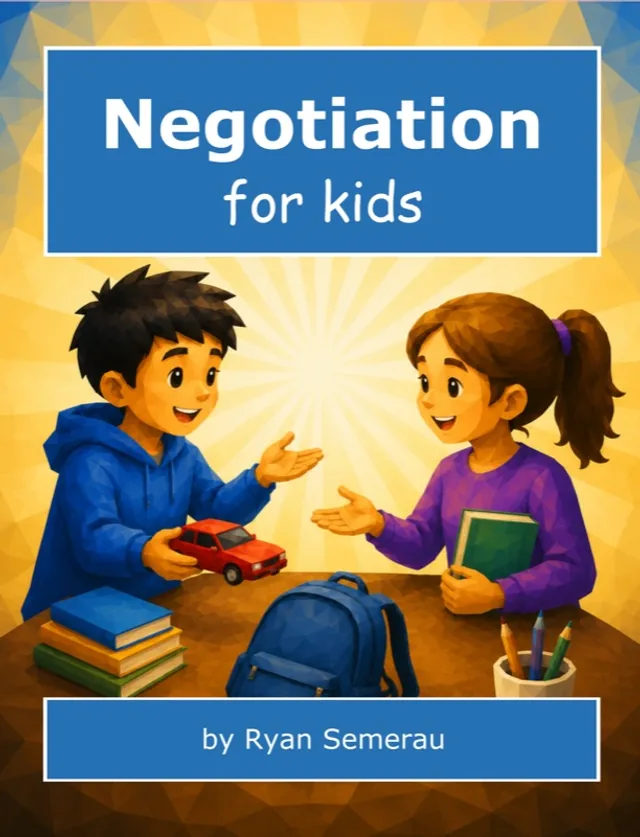
Negotiation for Kids
by Ryan Semerau
Negotiation is a skill everyone uses every day but nobody teaches. This book changes that. It teaches kids that negotiation is not fighting and not caving - it's finding agreements both sides can accept. Covers interests vs positions, preparation, BATNA, leverage, listening, tactical empathy, anchoring, creating value, fairness, influence, handling hardball tactics, managing emotions, and everyday application.
Contents
16 chapters · 76 lessons · first 6 free- IntroductionFree
1 · Foundations
- 1.1 · Not Fighting, Not CavingFree
- 1.2 · Negotiation Is EverywhereFree
- 1.3 · Good Negotiators vs Bad NegotiatorsFree
- 1.4 · The Goal: Agreement Both Sides Can AcceptFree
- Chapter 1 TestFree
2 · Positions vs Interests
- 2.1 · What's a Position?Free
- 2.2 · What's an Interest?🔒
- 2.3 · The Orange Story🔒
- 2.4 · Finding Interests🔒
- Chapter 2 Test🔒
3 · Preparation
- 3.1 · Most Negotiations Are Won Before They Start🔒
- 3.2 · Know What You Want🔒
- 3.3 · Know What They Want🔒
- 3.4 · Plan Your Approach🔒
- Chapter 3 Test🔒
4 · BATNA - Your Walk-Away Power
- 4.1 · What Is a BATNA?🔒
- 4.2 · Why BATNA Is Your Power🔒
- 4.3 · Building Your BATNA🔒
- 4.4 · Knowing When to Walk Away🔒
- Chapter 4 Test🔒
5 · Leverage
- 5.1 · What Is Leverage?🔒
- 5.2 · Types of Leverage🔒
- 5.3 · Using Leverage Without Being Mean🔒
- 5.4 · When They Have More Leverage🔒
- Chapter 5 Test🔒
6 · Listening and Asking Questions
- 6.1 · Talk Less, Learn More🔒
- 6.2 · Mirroring🔒
- 6.3 · Calibrated Questions🔒
- 6.4 · The Power of Silence🔒
- Chapter 6 Test🔒
7 · Tactical Empathy
- 7.1 · What Is Tactical Empathy?🔒
- 7.2 · Labeling🔒
- 7.3 · Getting to "That's Right"🔒
- 7.4 · The Accusation Audit🔒
- Chapter 7 Test🔒
8 · Anchoring and Opening
- 8.1 · What Is Anchoring?🔒
- 8.2 · Going First vs. Waiting🔒
- 8.3 · Aim High with a Reason🔒
- 8.4 · Responding to Their Anchor🔒
- Chapter 8 Test🔒
9 · Creating Value - Expanding the Pie
- 9.1 · Don't Just Split the Difference🔒
- 9.2 · Find the Trades🔒
- 9.3 · The Orange Story Revisited🔒
- 9.4 · Multiple Issues Help🔒
- Chapter 9 Test🔒
10 · Fairness and Objective Standards
- 10.1 · Why Fairness Matters🔒
- 10.2 · Objective Criteria🔒
- 10.3 · "That's Fair Because..."🔒
- 10.4 · When They Say It's Not Fair🔒
- Chapter 10 Test🔒
11 · Influence and Persuasion
- 11.1 · Reciprocity🔒
- 11.2 · Commitment and Consistency🔒
- 11.3 · Social Proof and Scarcity🔒
- 11.4 · Liking and Rapport🔒
- Chapter 11 Test🔒
12 · Saying No and Handling Hard Tactics
- 12.1 · Saying No Without Burning Bridges🔒
- 12.2 · Recognizing Hard Tactics🔒
- 12.3 · Responding to Hard Tactics🔒
- 12.4 · When to Walk Away🔒
- Chapter 12 Test🔒
13 · Emotions and Staying Calm
- 13.1 · Your Biggest Enemy Is Your Own Frustration🔒
- 13.2 · The Pause🔒
- 13.3 · Don't Take It Personally🔒
- 13.4 · Strategic Emotion🔒
- Chapter 13 Test🔒
14 · Everyday Negotiations
- 14.1 · Negotiating with Parents🔒
- 14.2 · Negotiating with Friends🔒
- 14.3 · Negotiating with Siblings🔒
- 14.4 · Negotiating at School🔒
- Chapter 14 Test🔒
15 · Becoming a Better Negotiator
- 15.1 · Practice Every Day🔒
- 15.2 · The Negotiation Journal🔒
- 15.3 · Know Your Style🔒
- 15.4 · The Skill That Changes Everything🔒
- Chapter 15 Test🔒
What you'll learn
- ✓The difference between positions and interests - and why it matters
- ✓How to prepare for any negotiation
- ✓What BATNA is and how it gives you walk-away power
- ✓How leverage works and how to build it
- ✓How to listen well and ask the right questions
- ✓What tactical empathy is and how to use it
- ✓How anchoring shapes the deal
- ✓How to create value and expand the pie
- ✓How to use fairness and objective standards
- ✓How influence and persuasion work
- ✓How to say no and handle hard tactics
- ✓How to manage your emotions and stay calm
- ✓How to apply negotiation skills in everyday life
How to use this workbook
15 chapters, designed for one chapter per week (4 short lessons per week plus a chapter test). Each lesson takes about 15-20 minutes - read the lesson, talk it over with the AI tutor, then answer a few short questions in your own words.
Prerequisites
None. This book stands alone. The Conversation for Kids and Rhetoric for Kids books are helpful companions but not required.