Included with subscription
A subscription unlocks every workbook. Preview chapters are always free.
Subscribe for full accessSign in to start previewFirst 6 lessons free. Adds to your library so you can pick up later.
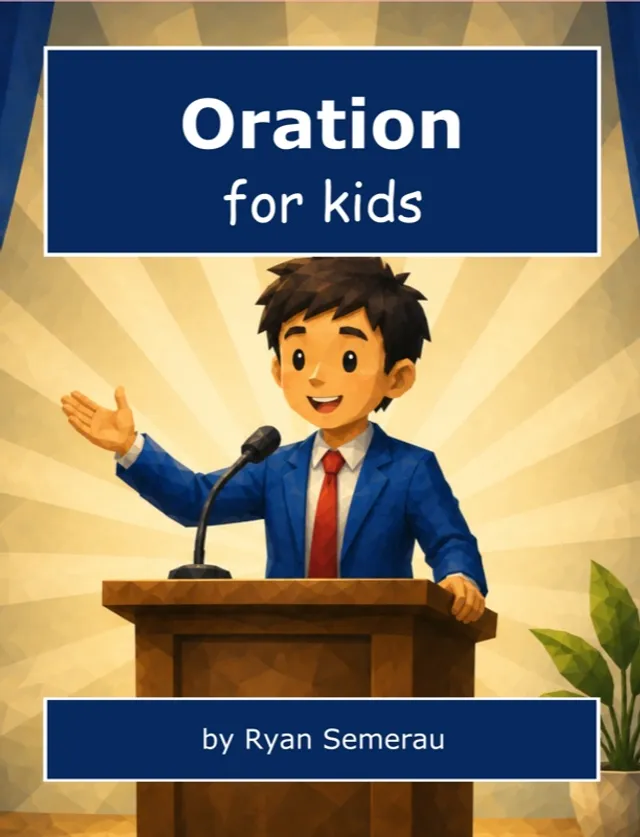
Oration for Kids
by Ryan Semerau
A standalone book on the craft of speaking well in any situation. Teaches voice control, pace and rhythm, emphasis, body language, managing nervousness, storytelling, and effective communication for different purposes - persuading, informing, entertaining, and comforting. Practical speaking skills in plain language for young readers.
Contents
16 chapters · 76 lessons · first 6 free- IntroductionFree
1 · Foundations of Oration
- 1.1 · More Than Public SpeakingFree
- 1.2 · The CraftFree
- 1.3 · Different Purposes, Same CraftFree
- 1.4 · Why It MattersFree
- Chapter 1 TestFree
2 · Your Voice as an Instrument
- 2.1 · Your Voice Is an InstrumentFree
- 2.2 · Volume and Projection🔒
- 2.3 · Tone and Pitch🔒
- 2.4 · Range and Resonance🔒
- Chapter 2 Test🔒
3 · Pace, Pause, and Rhythm
- 3.1 · Pace: How Fast You Speak🔒
- 3.2 · The Power of the Pause🔒
- 3.3 · Rhythm🔒
- 3.4 · Variation Is Everything🔒
- Chapter 3 Test🔒
4 · Emphasis and Stress
- 4.1 · Every Sentence Has Key Words🔒
- 4.2 · Stress Through Volume and Pitch🔒
- 4.3 · Stress Through Pause🔒
- 4.4 · Building to a Point🔒
- Chapter 4 Test🔒
5 · Body Language and Presence
- 5.1 · Your Body Speaks Too🔒
- 5.2 · Posture and Stance🔒
- 5.3 · Eye Contact🔒
- 5.4 · Gestures and Movement🔒
- Chapter 5 Test🔒
6 · Managing Nervousness
- 6.1 · Nervousness Is Normal🔒
- 6.2 · Reframing: Nerves as Energy🔒
- 6.3 · Preparation Reduces Anxiety🔒
- 6.4 · Practical Techniques🔒
- Chapter 6 Test🔒
7 · Storytelling
- 7.1 · Why Stories Work🔒
- 7.2 · Story Structure🔒
- 7.3 · Details That Matter🔒
- 7.4 · The Point🔒
- Chapter 7 Test🔒
8 · Types of Speaking Situations
- 8.1 · Prepared Speeches🔒
- 8.2 · Extemporaneous Speaking🔒
- 8.3 · Impromptu Speaking🔒
- 8.4 · Conversation and Ceremony🔒
- Chapter 8 Test🔒
9 · Speaking to Persuade
- 9.1 · Persuasion as Oration🔒
- 9.2 · Conviction🔒
- 9.3 · Building the Emotional Arc🔒
- 9.4 · The Call to Action🔒
- Chapter 9 Test🔒
10 · Speaking to Inform and Explain
- 10.1 · When the Goal Is Understanding🔒
- 10.2 · Start Where the Audience Is🔒
- 10.3 · Structure for Clarity🔒
- 10.4 · Analogies and Checks🔒
- Chapter 10 Test🔒
11 · Speaking to Entertain
- 11.1 · Entertainment as Oration🔒
- 11.2 · Humor🔒
- 11.3 · Comic Timing🔒
- 11.4 · Entertaining Without Jokes🔒
- Chapter 11 Test🔒
12 · Speaking in Difficult Situations
- 12.1 · Delivering Bad News🔒
- 12.2 · Speaking Under Pressure🔒
- 12.3 · Handling Hostility🔒
- 12.4 · Comforting and Consoling🔒
- Chapter 12 Test🔒
13 · Listening as Part of Oration
- 13.1 · Great Speakers Are Great Listeners🔒
- 13.2 · Active Listening🔒
- 13.3 · Reading the Room🔒
- 13.4 · Dialogue🔒
- Chapter 13 Test🔒
14 · Learning from Great Orators
- 14.1 · Study Great Speakers🔒
- 14.2 · Different Styles, Same Craft🔒
- 14.3 · What to Listen For🔒
- 14.4 · Finding Your Own Models🔒
- Chapter 14 Test🔒
15 · The Orator's Craft
- 15.1 · The Toolkit🔒
- 15.2 · Practice Is the Path🔒
- 15.3 · Finding Your Voice🔒
- 15.4 · A Lifelong Skill🔒
- Chapter 15 Test🔒
What you'll learn
- ✓What oration is and why speaking well matters
- ✓How to use your voice as an instrument - projection, tone, pitch, and range
- ✓How pace, pause, and rhythm hold attention
- ✓How emphasis and stress change meaning
- ✓How body language and presence communicate before you say a word
- ✓How to manage nervousness and channel it into energy
- ✓How to tell a great story with structure, details, and a point
- ✓How to handle different speaking situations - prepared, extemporaneous, and impromptu
- ✓How to speak to persuade, inform, explain, and entertain
- ✓How to speak in difficult situations - bad news, pressure, and hostility
- ✓How listening makes you a better speaker
- ✓How to learn from great orators and find your own voice
How to use this workbook
15 chapters, designed for one chapter per week (4 short lessons per week plus a chapter test). Each lesson takes about 15-20 minutes - read the lesson, talk it over with the AI tutor, then answer a few short questions in your own words. Many lessons include practice exercises to do out loud.
Prerequisites
None required. Rhetoric for Kids Books 1-2 recommended as they provide the theoretical foundation for persuasion, but this book teaches the craft of speaking on its own terms.