Included with subscription
A subscription unlocks every workbook. Preview chapters are always free.
Subscribe for full accessSign in to start previewFirst 6 lessons free. Adds to your library so you can pick up later.
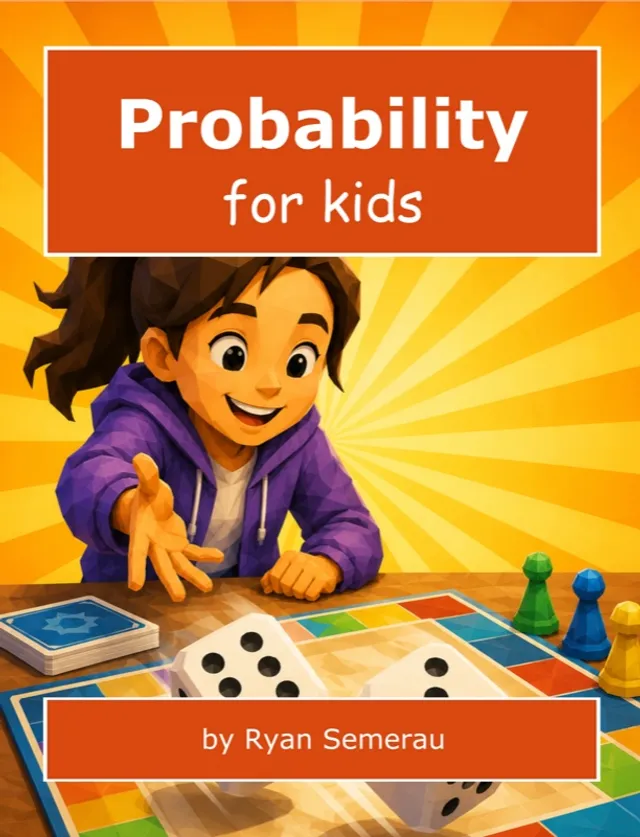
Probability for Kids
by Ryan Semerau
The first book in the Probability and Statistics for Kids series. Teaches probability from the ground up - what chance means, how to calculate it, how to combine probabilities, expected value, the law of large numbers, distributions, and common mistakes. Real examples with coins, dice, cards, games, weather, and sports make the math concrete and fun.
Contents
16 chapters · 76 lessons · first 6 free- IntroductionFree
1 · Foundations
- 1.1 · Things We Don't Know For SureFree
- 1.2 · The Probability ScaleFree
- 1.3 · Equally Likely OutcomesFree
- 1.4 · Probability in Everyday LanguageFree
- Chapter 1 TestFree
2 · Outcomes and Sample Spaces
- 2.1 · What Is an OutcomeFree
- 2.2 · The Sample Space🔒
- 2.3 · What Is an Event🔒
- 2.4 · Listing All Possibilities🔒
- Chapter 2 Test🔒
3 · Calculating Simple Probabilities
- 3.1 · The Basic Rule🔒
- 3.2 · Fractions, Decimals, and Percentages🔒
- 3.3 · Probability of NOT Happening🔒
- 3.4 · Practice: Coins, Dice, and Cards🔒
- Chapter 3 Test🔒
4 · "Or" Probabilities
- 4.1 · What's the Probability of This OR That🔒
- 4.2 · Mutually Exclusive Events🔒
- 4.3 · Overlapping Events🔒
- 4.4 · The Addition Rule🔒
- Chapter 4 Test🔒
5 · "And" Probabilities
- 5.1 · What's the Probability of This AND That🔒
- 5.2 · Independent Events🔒
- 5.3 · Dependent Events🔒
- 5.4 · The Multiplication Rule🔒
- Chapter 5 Test🔒
6 · Conditional Probability
- 6.1 · What Is Conditional Probability🔒
- 6.2 · How It Changes the Math🔒
- 6.3 · Everyday Conditional Probability🔒
- 6.4 · The Difference It Makes🔒
- Chapter 6 Test🔒
7 · Counting Methods
- 7.1 · The Counting Principle🔒
- 7.2 · When Order Matters: Permutations🔒
- 7.3 · When Order Doesn't Matter: Combinations🔒
- 7.4 · Using Counting to Find Probabilities🔒
- Chapter 7 Test🔒
8 · Expected Value
- 8.1 · What Is Expected Value🔒
- 8.2 · How to Calculate It🔒
- 8.3 · Fair and Unfair Games🔒
- 8.4 · Expected Value in Real Decisions🔒
- Chapter 8 Test🔒
9 · The Law of Large Numbers
- 9.1 · Short Run vs Long Run🔒
- 9.2 · Why Averages Stabilize🔒
- 9.3 · The Gambler's Fallacy🔒
- 9.4 · Sample Size Matters🔒
- Chapter 9 Test🔒
10 · Randomness
- 10.1 · What Does Random Mean🔒
- 10.2 · Humans Are Bad at Recognizing Randomness🔒
- 10.3 · Patterns That Aren't Real🔒
- 10.4 · Simulations: Using Randomness on Purpose🔒
- Chapter 10 Test🔒
11 · Probability Distributions
- 11.1 · What Is a Distribution🔒
- 11.2 · Uniform Distributions🔒
- 11.3 · The Bell Curve🔒
- 11.4 · Skewed and Other Shapes🔒
- Chapter 11 Test🔒
12 · Odds, Risk, and Probability in the Real World
- 12.1 · Odds vs Probability🔒
- 12.2 · Absolute vs Relative Risk🔒
- 12.3 · Medical Testing and False Positives🔒
- 12.4 · Weather Forecasts and Probability🔒
- Chapter 12 Test🔒
13 · Common Probability Mistakes
- 13.1 · Ignoring Base Rates🔒
- 13.2 · The Conjunction Fallacy🔒
- 13.3 · Assuming Independence🔒
- 13.4 · Confusing "Unlikely" with "Impossible"🔒
- Chapter 13 Test🔒
14 · Games, Gambling, and Strategy
- 14.1 · Probability in Games🔒
- 14.2 · The House Edge🔒
- 14.3 · Strategy and Probability🔒
- 14.4 · Risk vs Reward in Games🔒
- Chapter 14 Test🔒
15 · Probability as a Way of Thinking
- 15.1 · The Probability Toolkit🔒
- 15.2 · Thinking in Probabilities🔒
- 15.3 · Probability and Good Decisions🔒
- 15.4 · What You Know Now🔒
- Chapter 15 Test🔒
What you'll learn
- ✓What probability is and how to measure it
- ✓How to list outcomes and define sample spaces
- ✓How to calculate simple probabilities using fractions, decimals, and percentages
- ✓How to combine probabilities with 'or' and 'and' rules
- ✓What conditional probability is and why it matters
- ✓How to count possibilities using permutations and combinations
- ✓What expected value is and how to use it for decisions
- ✓Why averages stabilize over time (the law of large numbers)
- ✓What randomness really means and why humans misjudge it
- ✓How probability distributions describe patterns of chance
- ✓How to interpret odds, risk, and real-world probability claims
- ✓How to spot and avoid common probability mistakes
How to use this workbook
15 chapters, designed for one chapter per week (4 short lessons per week plus a chapter test). Each lesson takes about 15-20 minutes - read the lesson, talk it over with the AI tutor, then answer a few short questions in your own words.
Prerequisites
Basic arithmetic (addition, subtraction, multiplication, division). Fractions and percentages are used throughout the book but are explained as they come up. No prior knowledge of probability is required.