Included with subscription
A subscription unlocks every workbook. Preview chapters are always free.
Subscribe for full accessSign in to start previewFirst 6 lessons free. Adds to your library so you can pick up later.
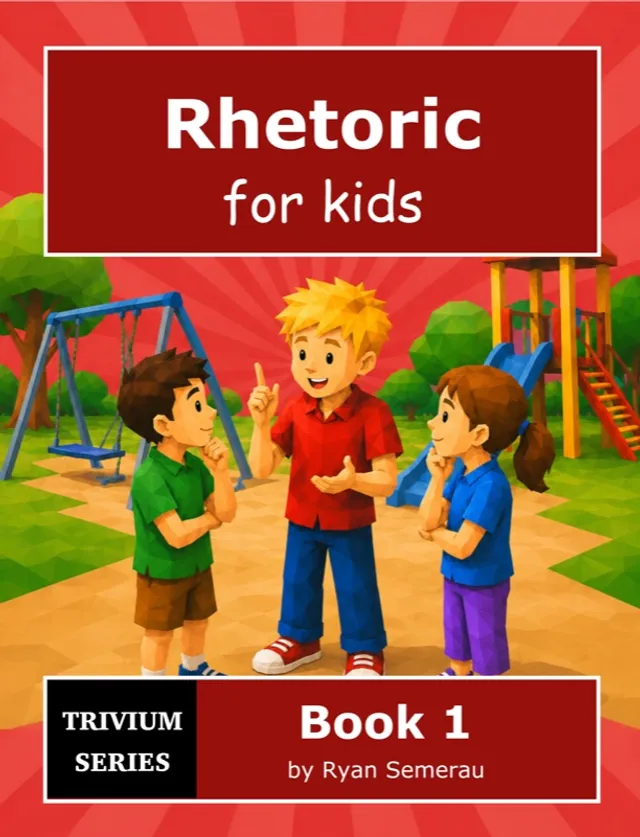
Rhetoric for Kids - Book 1
by Ryan Semerau
The first book in the Rhetoric for Kids series. Introduces the three appeals (logos, ethos, pathos), audience analysis, types of rhetoric, the five canons of rhetoric, kairos, rhetorical strategies, and figures of speech. A classical approach to persuasion in plain language for young readers.
Contents
16 chapters · 76 lessons · first 6 free- IntroductionFree
1 · Foundations of Rhetoric
- 1.1 · The Third ArtFree
- 1.2 · What Rhetoric IsFree
- 1.3 · Persuasion vs ManipulationFree
- 1.4 · Why Rhetoric MattersFree
- Chapter 1 TestFree
2 · The Three Appeals - Overview
- 2.1 · Aristotle's Three ModesFree
- 2.2 · Logos: The Argument🔒
- 2.3 · Ethos: The Speaker🔒
- 2.4 · Pathos: The Audience🔒
- Chapter 2 Test🔒
3 · Logos - The Logical Appeal
- 3.1 · Logic as the Foundation🔒
- 3.2 · Evidence🔒
- 3.3 · Reasoning the Audience Can Follow🔒
- 3.4 · Enthymemes in Rhetoric🔒
- Chapter 3 Test🔒
4 · Ethos - The Speaker's Credibility
- 4.1 · Why Credibility Matters🔒
- 4.2 · Three Components of Ethos🔒
- 4.3 · How Ethos Is Built🔒
- 4.4 · Ethos and Authority🔒
- Chapter 4 Test🔒
5 · Pathos - The Emotional Appeal
- 5.1 · What Pathos Is🔒
- 5.2 · Honest Pathos vs Emotional Manipulation🔒
- 5.3 · Understanding the Audience's Emotions🔒
- 5.4 · When Pathos Is Appropriate🔒
- Chapter 5 Test🔒
6 · The Audience
- 6.1 · Everything Depends on the Audience🔒
- 6.2 · Understanding Who You're Talking To🔒
- 6.3 · Common Ground🔒
- 6.4 · Friendly, Neutral, and Hostile Audiences🔒
- Chapter 6 Test🔒
7 · Types of Rhetoric
- 7.1 · Deliberative: What Should We Do🔒
- 7.2 · Forensic: What Happened🔒
- 7.3 · Epideictic: What Do We Value🔒
- 7.4 · Most Rhetoric Is a Mix🔒
- Chapter 7 Test🔒
8 · Invention - Finding What to Say
- 8.1 · What Is Invention🔒
- 8.2 · The Topics (Topoi)🔒
- 8.3 · Stasis Theory: Finding the Core Question🔒
- 8.4 · Brainstorming and Selection🔒
- Chapter 8 Test🔒
9 · Arrangement - Organizing the Argument
- 9.1 · What Is Arrangement🔒
- 9.2 · The Classical Structure🔒
- 9.3 · Ordering for Impact🔒
- 9.4 · Transitions🔒
- Chapter 9 Test🔒
10 · Style - Choosing the Right Words
- 10.1 · What Is Style🔒
- 10.2 · Clarity Above All🔒
- 10.3 · The Three Levels of Style🔒
- 10.4 · Diction: Word Choice🔒
- Chapter 10 Test🔒
11 · Memory and Delivery
- 11.1 · Memory: Knowing Your Material🔒
- 11.2 · Techniques for Memory🔒
- 11.3 · Delivery: How You Present🔒
- 11.4 · Written Delivery🔒
- Chapter 11 Test🔒
12 · Kairos - Timing and Context
- 12.1 · What Is Kairos🔒
- 12.2 · Reading the Situation🔒
- 12.3 · Opportunity🔒
- 12.4 · Appropriateness and Decorum🔒
- Chapter 12 Test🔒
13 · Rhetorical Strategies
- 13.1 · Narrative: Telling a Story🔒
- 13.2 · Framing🔒
- 13.3 · Concession and Refutation🔒
- 13.4 · Rhetorical Questions and Amplification🔒
- Chapter 13 Test🔒
14 · Figures of Speech
- 14.1 · Metaphor and Simile🔒
- 14.2 · Analogy in Rhetoric🔒
- 14.3 · Repetition Patterns🔒
- 14.4 · Antithesis and Irony🔒
- Chapter 14 Test🔒
15 · The Complete Art of Persuasion
- 15.1 · The Three Appeals in Balance🔒
- 15.2 · The Five Canons as a Process🔒
- 15.3 · Rhetoric as Responsibility🔒
- 15.4 · What Comes Next🔒
- Chapter 15 Test🔒
What you'll learn
- ✓What rhetoric is and its place in the Trivium
- ✓The three appeals: logos, ethos, and pathos
- ✓How to analyze and adapt to your audience
- ✓The three types of rhetoric: deliberative, forensic, and epideictic
- ✓Invention - how to find the strongest arguments available
- ✓Arrangement - how to organize arguments for maximum impact
- ✓Style - how to choose the right words for the situation
- ✓Memory and delivery - how to internalize and present your case
- ✓Kairos - timing, context, and appropriateness
- ✓Rhetorical strategies like narrative, framing, and concession
- ✓Figures of speech: metaphor, analogy, repetition, antithesis, and irony
How to use this workbook
15 chapters, designed for one chapter per week (4 short lessons per week plus a chapter test). Each lesson takes about 15-20 minutes - read the lesson, talk it over with the AI tutor, then answer a few short questions in your own words.
Prerequisites
Grammar for Kids Books 1-3 and Logic for Kids Books 1-4 strongly recommended. Rhetoric builds directly on both Grammar and Logic. At minimum, a solid understanding of propositions, syllogisms, and fallacies is helpful.