Included with subscription
A subscription unlocks every workbook. Preview chapters are always free.
Subscribe for full accessSign in to start previewFirst 6 lessons free. Adds to your library so you can pick up later.
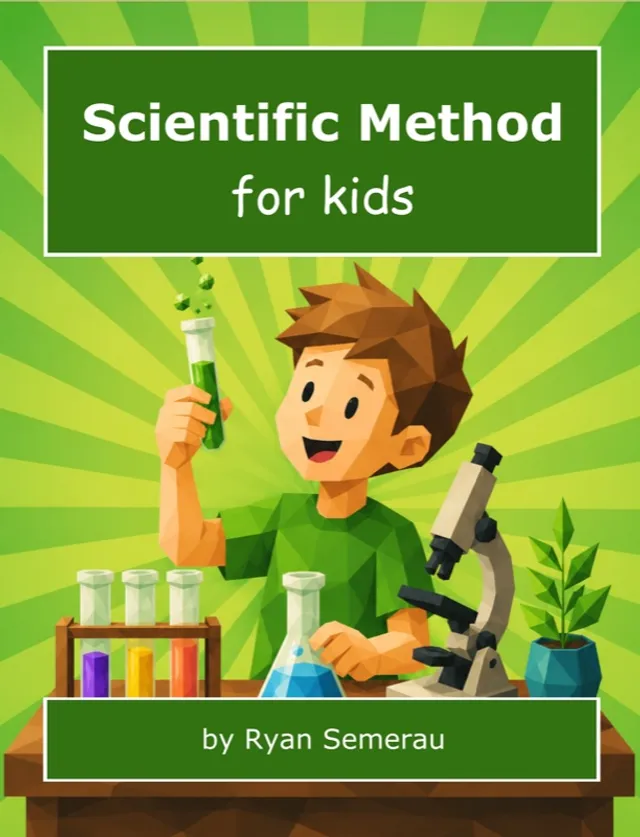
Scientific Method for Kids
by Ryan Semerau
A standalone book that teaches the scientific method as a way of thinking - not just memorizing steps. Covers observation, questions, hypotheses, experiments, data collection, analysis, conclusions, replication, peer review, bias, models, theories, and everyday application. Practical scientific reasoning in plain language for young readers.
Contents
16 chapters · 76 lessons · first 6 free- IntroductionFree
1 · The Basics
- 1.1 · Science Is a Method Not a SubjectFree
- 1.2 · How Science WorksFree
- 1.3 · What Makes Something ScientificFree
- 1.4 · Science Is ProvisionalFree
- Chapter 1 TestFree
2 · Observation
- 2.1 · Where It All StartsFree
- 2.2 · Careful Observation🔒
- 2.3 · Qualitative vs Quantitative Observations🔒
- 2.4 · Observing vs Interpreting🔒
- Chapter 2 Test🔒
3 · Questions
- 3.1 · Turning Observations into Questions🔒
- 3.2 · Testable vs Untestable Questions🔒
- 3.3 · Good Scientific Questions🔒
- 3.4 · The Power of "What Happens If"🔒
- Chapter 3 Test🔒
4 · Hypotheses
- 4.1 · What Is a Hypothesis🔒
- 4.2 · If-Then Statements🔒
- 4.3 · Falsifiability: Can It Be Proven Wrong🔒
- 4.4 · Multiple Hypotheses🔒
- Chapter 4 Test🔒
5 · Experiments
- 5.1 · What Is an Experiment🔒
- 5.2 · Variables🔒
- 5.3 · Control Groups🔒
- 5.4 · Fair Tests🔒
- Chapter 5 Test🔒
6 · Data Collection
- 6.1 · Measuring Carefully🔒
- 6.2 · Units and Consistency🔒
- 6.3 · Recording Data🔒
- 6.4 · Qualitative and Quantitative Data🔒
- Chapter 6 Test🔒
7 · Analyzing Results
- 7.1 · What Does the Data Show🔒
- 7.2 · Graphs and Visuals🔒
- 7.3 · Does the Evidence Support the Hypothesis🔒
- 7.4 · Evidence vs Proof🔒
- Chapter 7 Test🔒
8 · Drawing Conclusions
- 8.1 · What Can You Conclude🔒
- 8.2 · Alternative Explanations🔒
- 8.3 · Unexpected Results🔒
- 8.4 · What to Do Next🔒
- Chapter 8 Test🔒
9 · Replication
- 9.1 · Why Once Isn't Enough🔒
- 9.2 · Repeating Your Own Work🔒
- 9.3 · Others Repeating Your Work🔒
- 9.4 · When Results Can't Be Replicated🔒
- Chapter 9 Test🔒
10 · Peer Review and Publication
- 10.1 · Sharing Your Work🔒
- 10.2 · What Is Peer Review🔒
- 10.3 · Why Peer Review Matters🔒
- 10.4 · How Bad Science Gets Caught🔒
- Chapter 10 Test🔒
11 · Bias and Error
- 11.1 · What Is Bias🔒
- 11.2 · Confirmation Bias🔒
- 11.3 · Other Sources of Error🔒
- 11.4 · Blinding and Controls🔒
- Chapter 11 Test🔒
12 · Models and Theories
- 12.1 · What Is a Scientific Model🔒
- 12.2 · What Is a Scientific Theory🔒
- 12.3 · How Theories Change🔒
- 12.4 · The Difference Between Hypothesis, Theory, and Law🔒
- Chapter 12 Test🔒
13 · Science in Everyday Life
- 13.1 · You Already Think Scientifically🔒
- 13.2 · Evaluating Health Claims🔒
- 13.3 · Evaluating Product Claims🔒
- 13.4 · Science in the News🔒
- Chapter 13 Test🔒
14 · The Limits of Science
- 14.1 · What Science Can Answer🔒
- 14.2 · What Science Cannot Answer🔒
- 14.3 · Science and Other Ways of Knowing🔒
- 14.4 · Humility and Uncertainty🔒
- Chapter 14 Test🔒
15 · Thinking Like a Scientist
- 15.1 · The Scientific Habits of Mind🔒
- 15.2 · The Full Cycle🔒
- 15.3 · Connecting to Everything Else🔒
- 15.4 · Your Scientific Life🔒
- Chapter 15 Test🔒
What you'll learn
- ✓What science really is and why the method matters
- ✓How to observe carefully and notice what others miss
- ✓How to ask questions that can actually be tested
- ✓How to form a hypothesis - a testable guess
- ✓How to design a fair experiment
- ✓How to collect data and keep good records
- ✓How to analyze results and spot patterns
- ✓How to draw conclusions based on evidence
- ✓Why replication makes results trustworthy
- ✓How peer review and publication work
- ✓How bias and error can fool you - and how to guard against them
- ✓How models and theories help us understand the world
- ✓How to apply scientific thinking in everyday life
How to use this workbook
15 chapters, designed for one chapter per week (4 short lessons per week plus a chapter test). Each lesson takes about 15-20 minutes - read the lesson, talk it over with the AI tutor, then answer a few short questions in your own words.
Prerequisites
None. This book stands alone. No prior science knowledge is required.